

Progressive dialer: what it is, how it works, and when to pick it over predictive
A progressive dialer calls only when an agent is free: zero abandoned calls. What it is, how it works, and which operations it beats predictive on.
 RedacciónAstroline Team4 min read
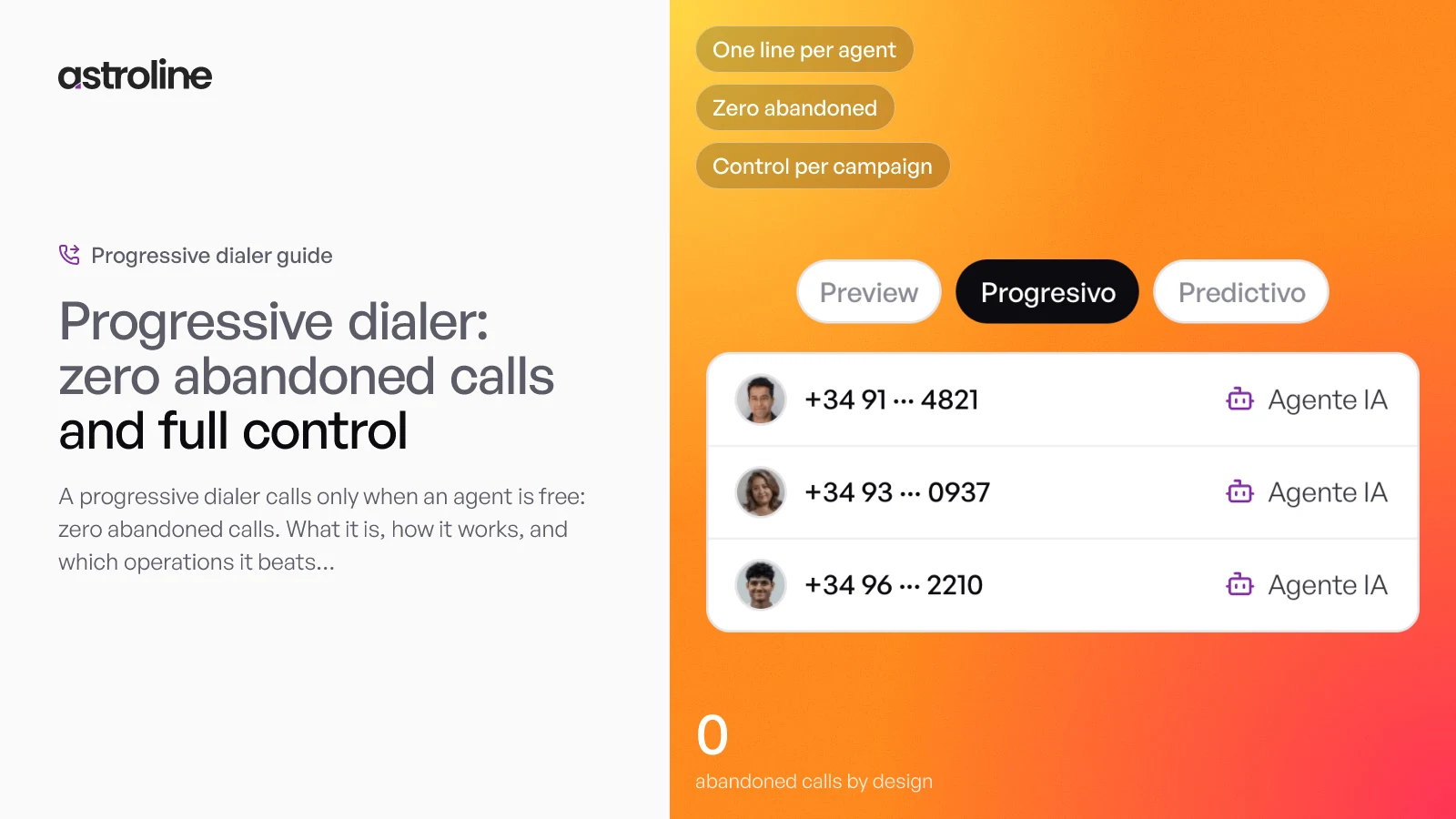
Between dialing by hand and the predictive dialer there is a middle ground many operations overlook: the progressive dialer. It doesn't maximize call volume, and that is exactly its value: it maximizes control. In this guide we explain what it is, how it works, and which campaigns should pick it before a predictive.
An agent dialing manually loses a good part of the day to ring tones, voicemails, and unanswered numbers. The progressive dialer removes that mechanical work without getting ahead of the risk: the machine dials for the agent, but only when the agent is truly free.
What a progressive dialer is
A progressive dialer is an automatic dialing system that calls only when an agent is available to take the call. It doesn't dial ahead: it keeps one line per agent (or a fixed configurable ratio, say two lines per agent), so every answered call has a person ready behind it.
Its promise is simple and verifiable: zero abandoned calls. Since it never dials without a free agent, there is no call a customer answers only to find silence. That silence is what US regulation punishes with the 3% abandonment cap (47 CFR 64.1200), and what burns your number reputation in any country.
How it works
The mechanics are deliberately simple:
The dialer watches each agent's state: on call, on pause, available.
When an agent becomes available, the system dials the next contact in the queue.
If a person answers, the call connects immediately to that agent.
If nobody answers or voicemail picks up, the system logs the result and moves to the next contact when appropriate.
There is no prediction, only direct causality between availability and dialing. That simplicity yields three operational wins: no call without an agent, clean information in your CRM (each agent knows what was dialed and what happened), and a learning curve of minutes for any team.
Progressive versus predictive: which to choose
Both automate dialing; the difference is the bet. Predictive launches more calls than agents because it predicts how many will go unanswered: it wins volume and assumes abandonment risk. Progressive doesn't bet: it dials only with a free agent, wins control, and gives up some volume.
Choose progressive when:
Your base is B2B or high-value: each contact matters more than cadence.
You work collections or sensitive topics, where an abandoned call damages the relationship.
Your market's or client's regulation is strict on abandonment.
Your answer rate is high: with plenty of useful contacts, predictive adds little.
You have new agents or campaigns that require reading context before speaking.
Choose predictive when you want volume over broad consumer bases, with low answer rates and an experienced team that keeps the pace. If you're still unsure, our predictive dialer guide breaks down pacing and its four modes.
And remember: the mode is not a contract. Mature operations switch modes per campaign, and even within a campaign by time band and base type.
Getting more out of progressive
Progressive removes dialing time, but the rest of the agent's hour is optimized by the ecosystem around it:
CRM integration so after-call work feeds the campaign's next move.
Voicemail detection before connecting: if voicemail answers, the system hangs up in milliseconds and the agent never notices; their time stays reserved for people.
Number reputation under control: progressive is worthless if your lines show up as "spam likely."
Callback scheduling inside the flow, so "call me tomorrow" becomes an automatic task.
Precisely because progressive is the most conservative mode, the real margin lies in infrastructure: route quality, number health, and early voicemail detection decide how many of those agent-ready contacts end in real conversations.
Conclusion
The progressive dialer is the mature choice for operations that prefer zero abandonment risk and maximum traceability over raw volume. Choosing between progressive and predictive is not about fashion but about fit: base type, contact value, regulation, and team maturity.
At Astroline we have spent 25 years integrating dialers of every mode over our own voice network, with numbering in more than 85 countries and voicemail detection before the phone is answered. If you are building your outbound operation, we help you choose the mode and the infrastructure that holds every call.

Keep reading
See all articles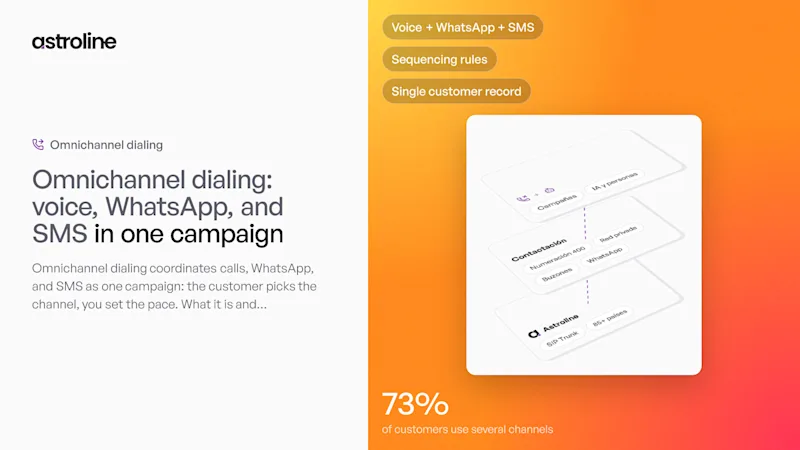
Omnichannel dialing: what it is and how to orchestrate voice, WhatsApp, and SMS
Omnichannel dialing coordinates calls, WhatsApp, and SMS as one campaign: the customer picks the channel, you set the pace. What it is and how to build it.
WhatsApp AI agents: what they are, what they can do, and how to integrate them
A WhatsApp AI agent handles, qualifies, and escalates conversations with no human behind. What they are, what they can really do, and how to integrate them.
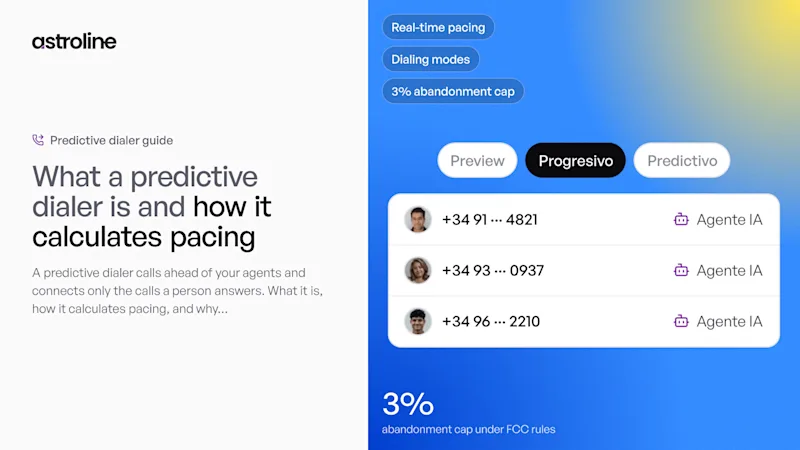
Predictive dialer: what it is, how it works, and when it stops being enough
A predictive dialer calls ahead of your agents and connects only the calls a person answers. What it is, how it calculates pacing, and why its result depends on the network behind it.
Newsletter
New articles, in your inbox.
Dialing, voice and AI, without the noise. Unsubscribe anytime.
By submitting, you agree to receive emails from Astroline. See how we handle your data in our privacy policy.