

Omnichannel dialing: what it is and how to orchestrate voice, WhatsApp, and SMS
Omnichannel dialing coordinates calls, WhatsApp, and SMS as one campaign: the customer picks the channel, you set the pace. What it is and how to build it.
 RedacciónAstroline Team4 min read
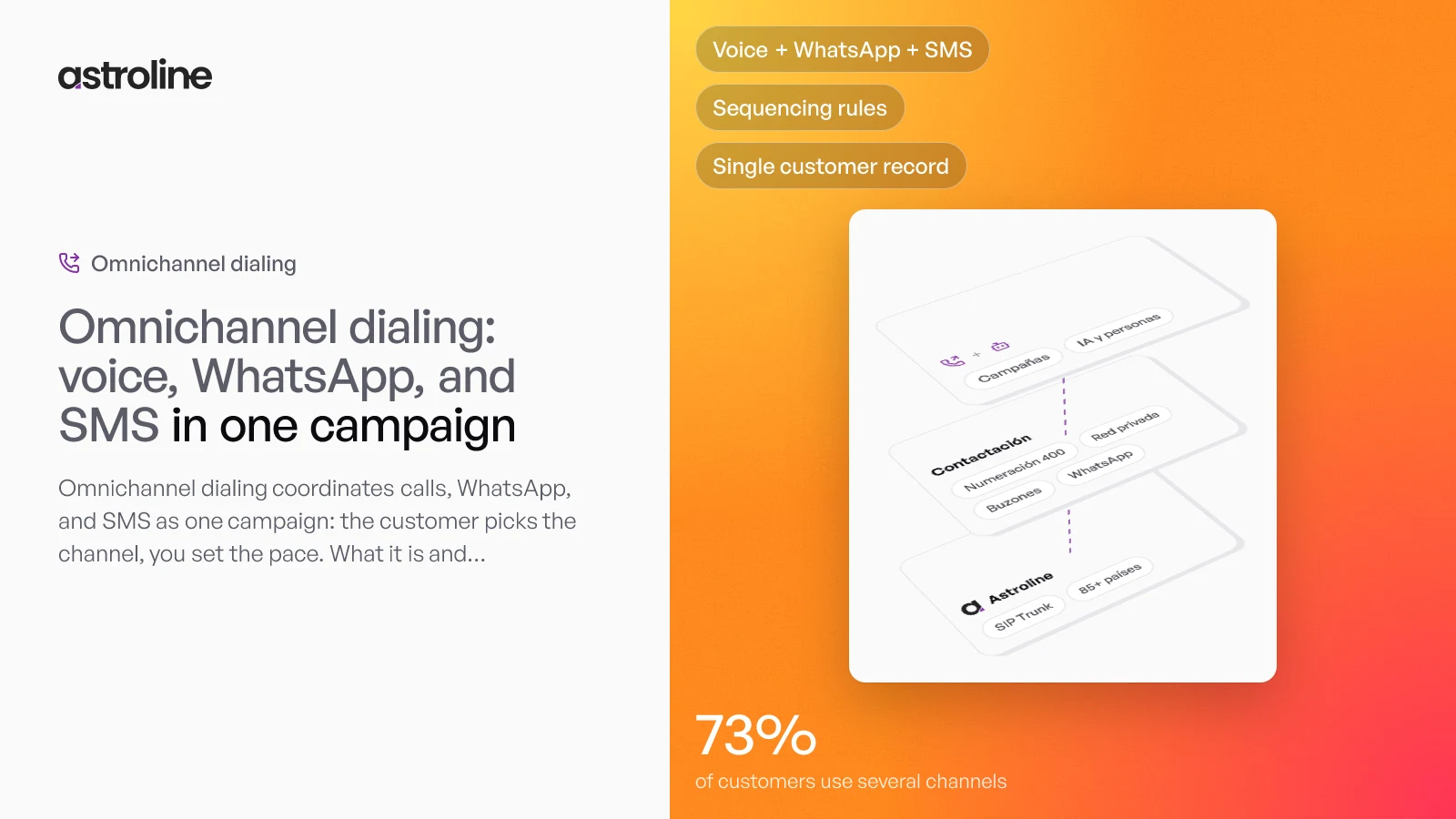
Your customer doesn't live in one channel. Most people interacting with companies already use several channels in a single journey: a Harvard Business Review study of 46,000 shoppers found that 73% used more than one channel during their shopping journey (Sopadjieva, Dholakia, and Foley, 2017). An operation that only calls leaves half the road uncovered.
Omnichannel dialing was born from that reality: a single campaign coordinating calls, WhatsApp messages, and SMS, deciding the channel and the moment of each attempt, and unifying the results. In this guide we explain what it is, how it works, and how to build it without breaking yourself.
What omnichannel dialing is
Omnichannel dialing is the ability of a contact operation to execute its campaigns over several coordinated channels: voice calls (with a dialer and agents, human or AI), WhatsApp messaging, and SMS, all sharing the same database, the same contact-frequency rules, and the same result log.
The opposite of omnichannel is not "having several channels," it's having them disconnected: the platform that dials on one side, the WhatsApp software on another, and SMS blasted blindly from a third. Three channels, three versions of the truth about the same customer.
The principle: each channel has its role
Omnichannel dialing doesn't treat all channels the same. Experience from real operations draws a clear division of labor:
Voice: the deep-conversation channel. It detects intent, resolves objections, closes. It is also the most expensive per attempt, and the one that suffers most from customer impatience.
WhatsApp: the immediate-response and follow-up channel. Read rates are extremely high and it accepts rich formats (images, buttons, location). Ideal to confirm, remind, and re-engage.
SMS: the universal-reach channel. No app or data plan required, it reaches any phone. Ideal for short notices and as plan B when the rest goes unanswered.
The classic sequence that works: WhatsApp or SMS announces and enables, the call converses and closes, a message confirms and follows up. Each channel does its job, and all of them share memory.
How it works inside
A mature omnichannel campaign rests on four pieces:
A single contact base with its true state: who was called, what happened, which channel they answered, when the last interaction was.
A rules engine deciding the next attempt: if the call goes unanswered, do I wait 24 hours or try WhatsApp today? If the WhatsApp was read but not answered, do I call? Those rules are the campaign's intelligence.
A dialer executing the voice part in its modes (preview, progressive, power, predictive) by base and campaign type. Our predictive dialer post breaks down how it picks the pace.
The voice infrastructure holding it all: reputable numbering in each country, voicemail detection before connecting, and carrier routes with failover. Without this, the multichannel campaign only multiplies failed attempts.
The four real benefits
Total contactability: you cover the customer who won't pick up but does read, and the one who doesn't read but does pick up. Voice-plus-messaging always beats any single channel.
Less customer fatigue: if someone already replied on WhatsApp, you don't call them twice more that day. Frequency is controlled, experience improves.
Single traceability: every attempt, on any channel, feeds the same record. The operation stops arguing about what happened and starts optimizing what to do.
Optimized cost per contact: the cheap channel qualifies, the expensive one closes. Choosing channel per attempt is the biggest cost lever of the decade.
How to build it: the minimum checklist
If you're considering the omnichannel leap, this is the list we review with any operation:
Is the base clean and consented? Omnichannel without frequency control is a multichannel spam machine.
Do you have reputable numbering in the countries you contact? Without a healthy number, neither WhatsApp nor voice works.
Can you detect voicemail before connecting? Every conversed voicemail is billed valueless minutes.
Does the rules engine truly exist, or do the channels just "coexist"? Ask to see the sequencing and frequency rules.
Do results from all channels land on the same customer record?
Do agents (human or AI) see the full multichannel history before speaking?
Conclusion
Omnichannel dialing is not another contact-center fad: it is the operational answer to how customers behave today, choosing channel and moment. Building it well is integration work: messaging, voice and WhatsApp AI, dialer, and telephony working as one system over a professional network.
At Astroline we are integrators: we connect omnichannel dialers and voice and WhatsApp AI agents with the voice network that holds every attempt, numbering in more than 85 countries, and voicemail detection before the phone is answered. If your operation is ready for the leap, start by telling us how you contact customers today.

Keep reading
See all articles
WhatsApp AI agents: what they are, what they can do, and how to integrate them
A WhatsApp AI agent handles, qualifies, and escalates conversations with no human behind. What they are, what they can really do, and how to integrate them.
Progressive dialer: what it is, how it works, and when to pick it over predictive
A progressive dialer calls only when an agent is free: zero abandoned calls. What it is, how it works, and which operations it beats predictive on.
Predictive dialer: what it is, how it works, and when it stops being enough
A predictive dialer calls ahead of your agents and connects only the calls a person answers. What it is, how it calculates pacing, and why its result depends on the network behind it.
Newsletter
New articles, in your inbox.
Dialing, voice and AI, without the noise. Unsubscribe anytime.
By submitting, you agree to receive emails from Astroline. See how we handle your data in our privacy policy.