

Predictive dialer: what it is, how it works, and when it stops being enough
A predictive dialer calls ahead of your agents and connects only the calls a person answers. What it is, how it calculates pacing, and why its result depends on the network behind it.
 RedacciónAstroline Team5 min read
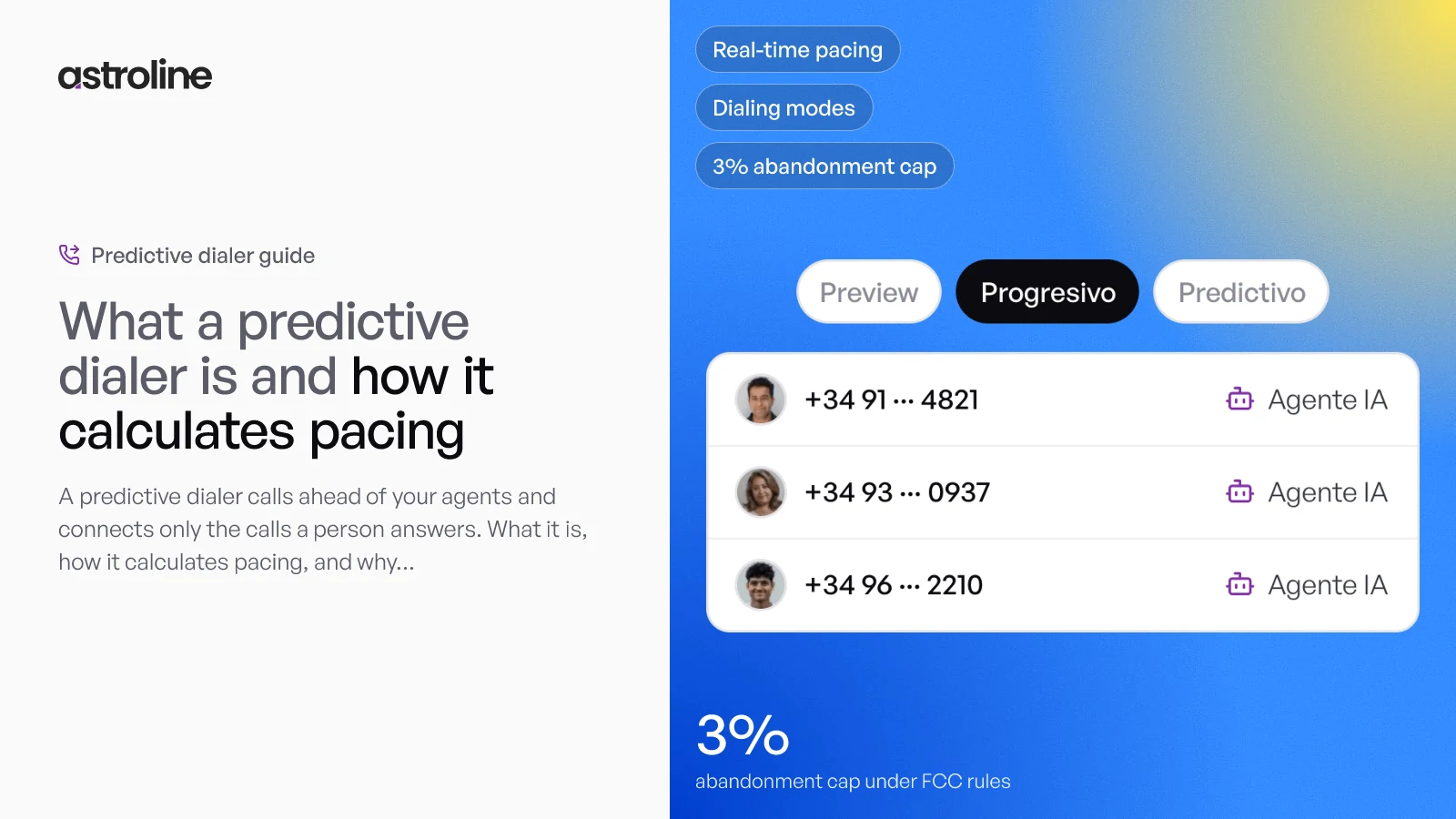
If your operation calls to sell, collect, or book appointments, the predictive dialer is the piece that decides how many meaningful contacts each agent produces every hour. In this guide we explain what it actually is, how it calculates its dialing pace, and why its real performance depends on the voice network behind it.
An agent dialing by hand spends a good part of the day dialing numbers, listening to rings, and waiting for no one. The predictive dialer was born to remove exactly that dead time: the machine dials ahead, and when a person answers, the call already lands on a free agent.
What a predictive dialer is
A predictive dialer is a system that automatically calls many numbers at once, ahead of your agents' availability. Its goal is one and very specific: no connected call should find a busy agent, and no free agent should sit waiting for a call.
The word that defines it is "predictive." It doesn't dial at random: it estimates, at every moment, how many calls it needs to launch so that the number of people who answer matches the number of agents about to become free. When the prediction is right, the operation produces contacts almost without pauses.
How it works: the math of pacing
The dialer's engine is pacing: the calculation that decides how many calls to launch at any instant. To do it, the system watches four variables in real time:
The average talk time of your connected calls.
After-call work: what the agent spends closing notes in the CRM after hanging up.
The campaign's answer rate, which shifts by time band and by base type.
The number of logged-in agents and their state: on call, on pause, available.
With those variables, the dialer launches more calls than there are free agents, because it knows many will go unanswered. Picture Ana and 19 other agents facing a 20% answer rate: launching 100 calls for 20 free agents is the bet that balances supply and demand. That extra margin is the essence of predictive dialing.
The four dialing modes
Not every operation needs the most aggressive mode. Modern dialers let you choose among several modes, and choosing well is part of the result:
Preview: the agent sees the customer record before deciding to call. Maximum control, minimum volume. For long-cycle sales or sensitive collections.
Progressive: the system dials only when an agent is free, without dialing ahead. No risk of abandoned calls, but fewer contacts per hour.
Power: dials a fixed number of lines per agent, usually two to three. A classic middle ground.
Predictive: dials ahead using the pacing calculation. Maximum contact volume, and also the mode that demands the most from your network and your regulatory compliance.
The dialer's limit: the network behind it
Here is the point most operations overlook. A perfect dialer connected to a mediocre network still fails to connect. The dialer optimizes the pace; contactability is decided by the voice infrastructure behind it.
Three network factors weigh more than any pacing tweak. First, number reputation: if your lines show up flagged as "spam likely," the answer rate collapses and the dialer loses its raw material. Second, voicemail detection: a voicemail is the customer who never buys and always gets paid for; detecting it in early media, before connecting, and hanging up in under 400 milliseconds saves minutes of billed conversation that are worth nothing. Third, routing: going out through quality carrier routes, over a private network with failover, holds the answer rate as the campaign scales.
If you want to go deeper on this side, we cover it in detail in our guide on outbound dialing and carrier infrastructure (in Spanish): why infrastructure decides your contactability.
The 3% rule: abandonment and compliance
Aggressive pacing has a legal ceiling. When the dialer overreaches, some calls are answered by a person and no agent is free: those are abandoned calls, silences that damage your brand and your numbers.
US regulation puts a number on it: the FCC caps abandonment at 3% of calls answered by a person, measured over 30 days, and requires the call to be transferred to an agent within 2 seconds (47 CFR 64.1200). Every abandoned call must still leave an identification message. A well-calibrated dialer keeps abandonment below that threshold without sacrificing volume; a poorly calibrated one turns time savings into fines and burned reputation.
Predictive dialing with AI voice agents
The predictive dialer was born with an assumption underneath: the agent is human, and agent time is the scarce resource. AI voice agents break that assumption. An AI agent needs no queue and no break, handles concurrent calls, and has no "after-call work." Pacing stops revolving around the human and starts optimizing for capacity, time of day, and cost.
The transition doesn't remove the dialer: it removes its bottleneck. Dialing is still necessary, but it can now sustain volumes no human team could absorb, with voicemail detection before connecting and healthy numbering. We develop this in our piece on dialing in the age of AI agents (in Spanish) and in our guide on AI voice agents for contact centers.
How to choose a dialer: the minimum checklist
Before signing with a vendor, check these seven points:
Support for all four modes, switchable per campaign, not per contract.
Transparent pacing: real-time abandonment and answer rates you can see.
The 3% abandonment cap as a configurable internal limit.
CRM integration, so after-call work is part of the calculation.
A carrier behind it with numbers in the countries you call: real coverage, not brochure coverage.
Voicemail detection before connecting, not after the greeting.
Readiness for AI voice agents, because pacing without humans is no longer science fiction.
The predictive dialer is a mature, proven piece. The difference between an operation that contacts and one that only calls lies in the whole: dialer, numbering, detection, and network. At Astroline we have spent 25 years sustaining that invisible part your contacts travel through, with numbering in more than 85 countries and voicemail detection before the phone is even answered.

Keep reading
See all articles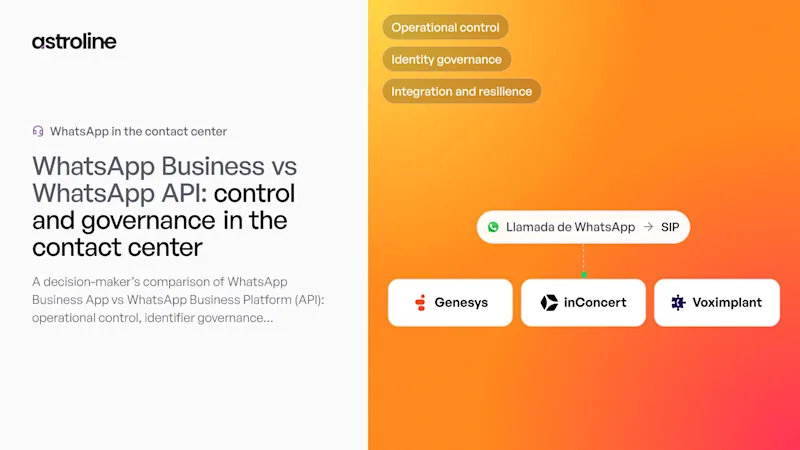
WhatsApp Business vs WhatsApp API (Cloud/On‑Prem): what changes in control, governance and scalability when it connects to a contact center
A decision-maker’s comparison of WhatsApp Business App vs WhatsApp Business Platform (API): operational control, identifier governance, compliance, integrations and resilience when WhatsApp becomes a contact center entry point.
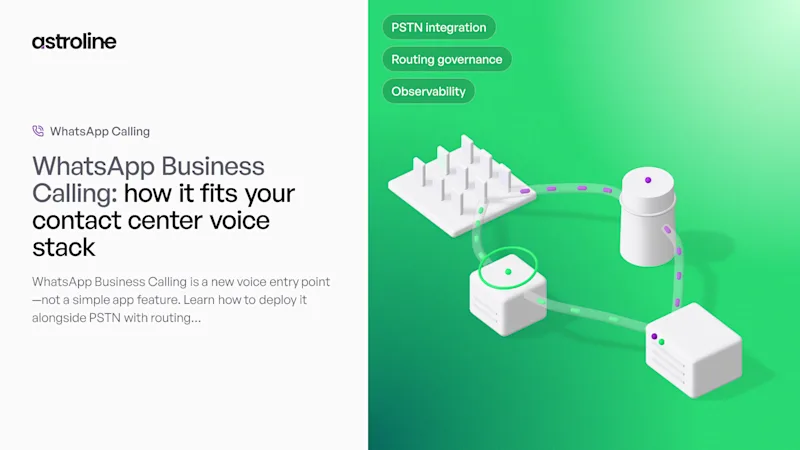
WhatsApp Business Calling: what it really is—and how to fit it into a Contact Center voice architecture
WhatsApp Business Calling is a new voice entry point—not a simple app feature. Learn how to deploy it alongside PSTN with routing governance, number reputation protection, and KPI-grade observability for contactability and answer rate.
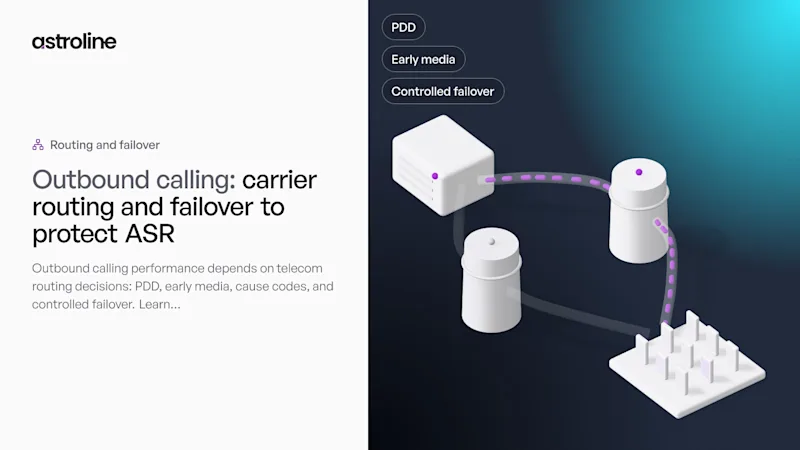
Outbound Calling: Carrier Routing & Failover Design to Protect ASR and Answer Rate
Outbound calling performance depends on telecom routing decisions: PDD, early media, cause codes, and controlled failover. Learn carrier-grade design patterns and route governance to stabilize ASR, answer rate, and cost per successful contact.
Newsletter
New articles, in your inbox.
Dialing, voice and AI, without the noise. Unsubscribe anytime.
By submitting, you agree to receive emails from Astroline. See how we handle your data in our privacy policy.