

Power dialer: what it is, how it works, and when to use it
What a power dialer is, how it chains calls with zero dead time, and when to choose it over progressive and predictive.
 RedacciónAstroline Team3 min read
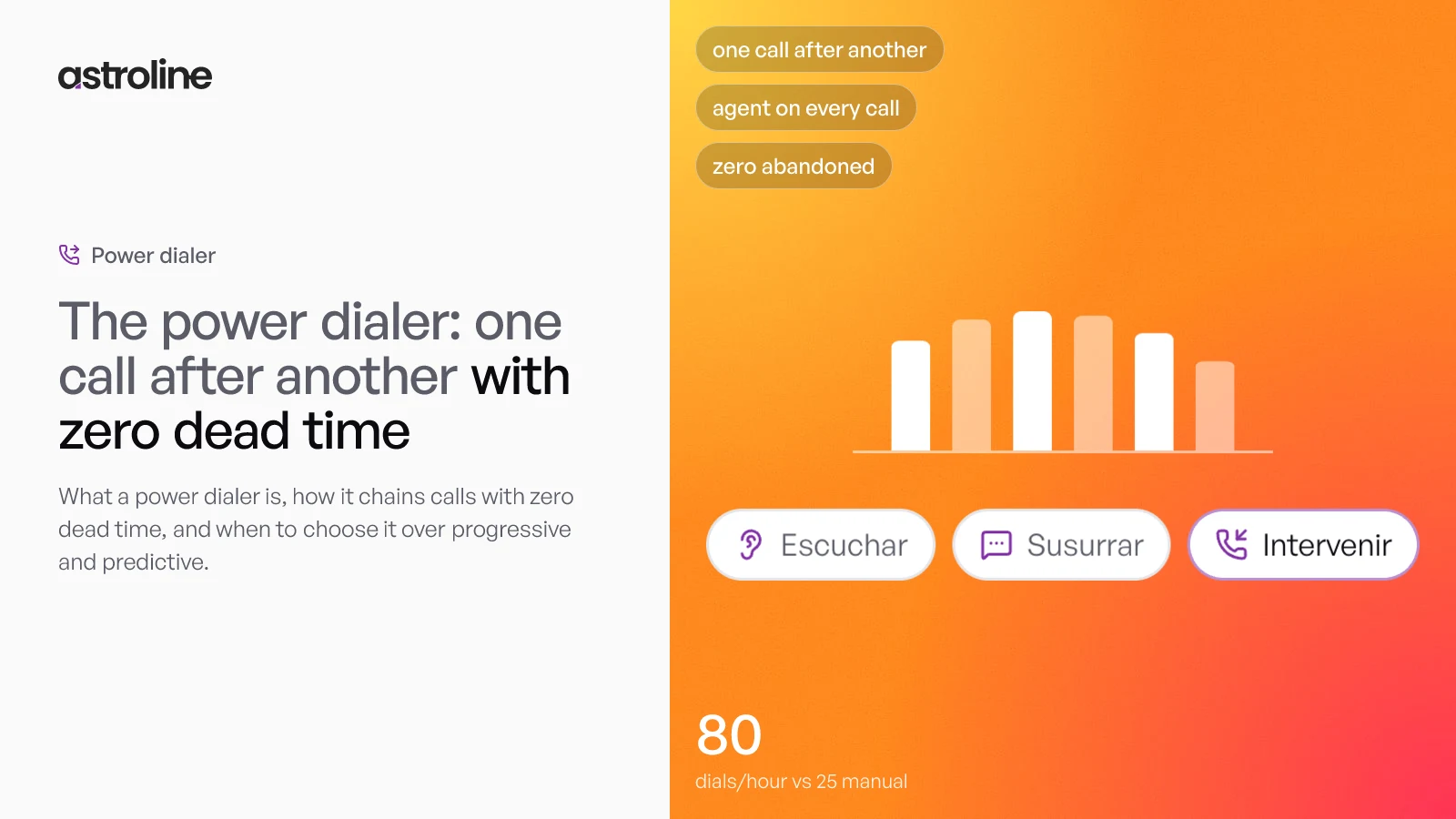
The power dialer is the third piece of the dialer family we are breaking down. If the progressive dialer paces the rhythm and the predictive dialer dials ahead, the power dialer is the middle ground: dialing speed without losing control of every conversation.
What a power dialer is
A power dialer chains the calls on a list one at a time, automatically. When a call ends —contact, voicemail, no answer— the system is already dialing the next one. The agent is present on every call: no manual dialing, no waiting through ring tones.
There are no multiple lines and no prediction algorithm: it is pure frictionless sequence. One call, one agent, zero dead time in between.
How it works, step by step
Ana starts her session with a segmented list. The dialer calls the first contact and Ana hears the ring with the record in front of her. If nobody answers or voicemail picks up, she logs the outcome with one click and the next call is already going out.
If the network detects a voicemail before handing the call over, Ana never sees it: only worthwhile contacts reach her. Every outcome gets logged, so follow-up builds itself.
When to choose it (and when not to)
The power dialer shines in these scenarios:
Warm lists and high-value accounts
Consultative selling, where every conversation weighs more than volume
Operations sensitive to abandoned calls: with a live agent on every call, none are abandoned. Klenty describes it as the most TCPA-compliant dialing method
And here is the full family, side by side:
Manual | Power | Progressive | Predictive | |
|---|---|---|---|---|
Pace | You dial | One after another | Queue-controlled rhythm | Dials ahead of the agent |
Lines | 1 | 1 | Several per agent | Many at once |
Agent on the call | Always | Always | On every connected contact | Only on live contacts |
Abandoned calls | 0 | 0 by design | Low if the pace is well tuned | Risk if the prediction misses |
Dials per hour | 25 | 80 | — | — |
Best for | Small lists | Warm lists and key accounts | Balancing volume and control | Pure volume on cold lists |
The dials-per-hour figures are what Klenty reports for manual and power in 2026; progressive and predictive have no comparable figure in that source, so they stay out of the numeric row.
If the goal is pure volume on cold lists, the progressive and predictive dialers cover that ground better.
What it improves, in numbers
Teams on a power dialer average 80 dials per hour versus 25 with manual dialing — roughly three times more with the same headcount, according to Klenty's 2026 data. The gain is not dialing faster: it is removing everything that happens between calls —keying numbers, waiting for tones, logging— and spending that time talking.
The network behind the dialer
A dialer is only as good as the voice that carries it. Astroline integrates the dialer with a private-network SIP trunk, phone numbers in more than 85 countries and voicemail detection before the call is handed over. Voice, WhatsApp and AI agents on the same infrastructure: every channel in the campaign works as one.
How to start
A pilot in three steps:
Pick a warm list and two weeks of testing
Track three things: dials per hour, contact rate and conversation-to-outcome
Compare against the same list dialed manually
Let the numbers do the talking.
Data point: 80 dials per hour versus 25 manual — Klenty, 2026.

Keep reading
See all articles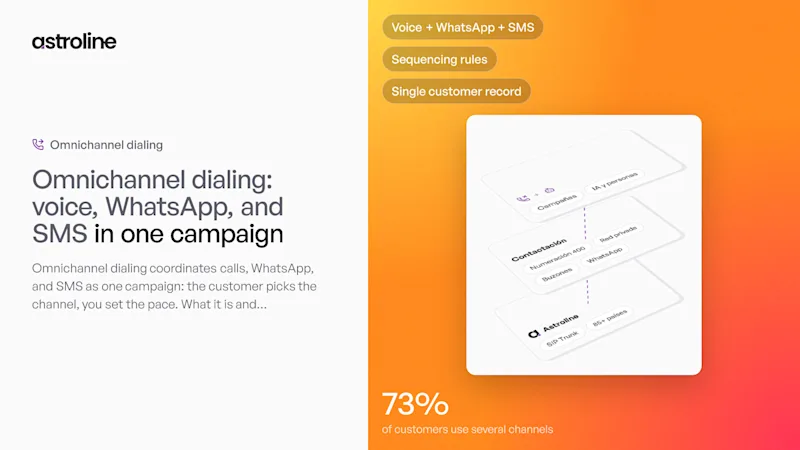
Omnichannel dialing: what it is and how to orchestrate voice, WhatsApp, and SMS
Omnichannel dialing coordinates calls, WhatsApp, and SMS as one campaign: the customer picks the channel, you set the pace. What it is and how to build it.
WhatsApp AI agents: what they are, what they can do, and how to integrate them
A WhatsApp AI agent handles, qualifies, and escalates conversations with no human behind. What they are, what they can really do, and how to integrate them.
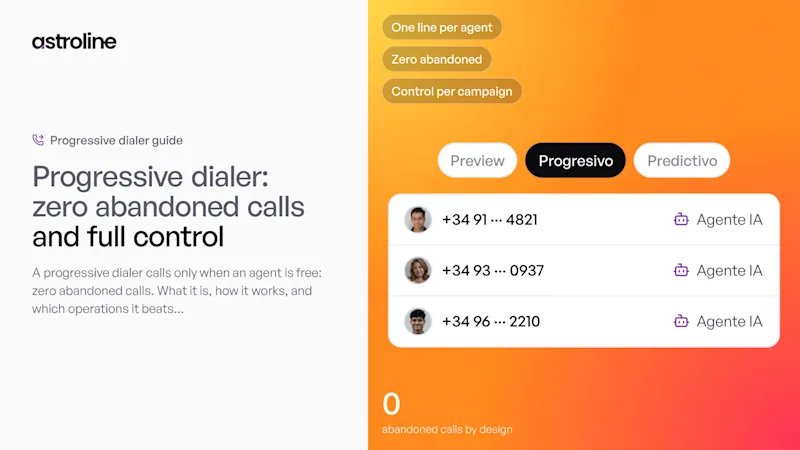
Progressive dialer: what it is, how it works, and when to pick it over predictive
A progressive dialer calls only when an agent is free: zero abandoned calls. What it is, how it works, and which operations it beats predictive on.
Newsletter
New articles, in your inbox.
Dialing, voice and AI, without the noise. Unsubscribe anytime.
By submitting, you agree to receive emails from Astroline. See how we handle your data in our privacy policy.