

Automated callback: what it is, when to turn it on, and what your queue gains
What an automated callback is, how it keeps the customer's place in line without waiting, and what each side gains: less abandonment, more connected calls.
 RedacciónAstroline Team4 min read
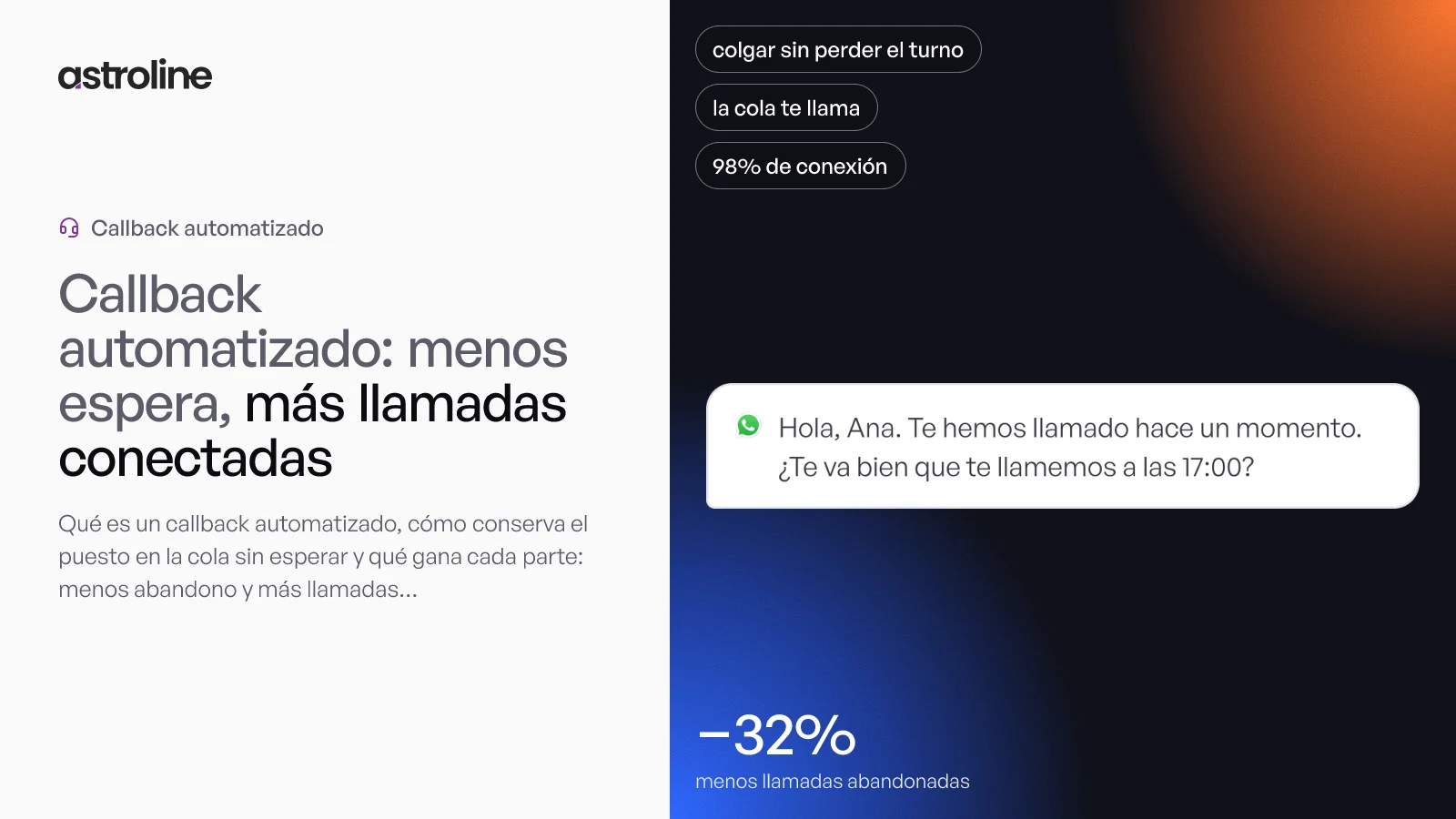
An automated callback is the option a call queue offers to call the customer back instead of making them wait: the system keeps their place in line and dials when an agent frees up. Studies by Contact Babel attribute at least 32% fewer abandoned calls to it. It is the most direct way to turn waiting into conversation.
What an automated callback is
An automated callback consists of offering the customer, while they wait in the queue, the chance to hang up without losing their turn: the voice platform records their number and position, and when an agent becomes free, the system places the return call.
It is not the same as asking the customer to "try again later." In a callback, the place in line is preserved: if the customer was next, the return call goes out in that order. And since the calling agent already sees the original contact reason on screen, nothing has to be repeated.
The call the customer receives is not an interruption: it is the answer to their request.
In a classic queue, the only alternative to waiting is abandoning. And patience is short: according to DialogTech's benchmarking analyses, more than 60% of callers hang up before the first minute on hold, and one third of those who hang up never call back.
How an automated callback works
The customer calls and enters the queue. The platform plays the usual hold announcement.
After a configurable threshold, thirty seconds for example, the message offers the callback: "if you'd rather we called you back, press one."
The customer accepts and hangs up. The system stores their number and their position in line.
When an agent frees up, the platform dials the customer. If they answer, they connect with that agent, who already sees the context of the original call on screen.
If the customer doesn't answer, the system retries according to the team's policy or returns the request to the queue without losing the turn.
- Step 1The customer calls
They enter the hold queue
- Step 2The callback is offered
After the defined threshold, thirty seconds for example
- Step 3Hang up, keep the place
The system stores their number and position in line
- Step 4The queue calls them
When an agent frees up
- Step 5With context on screen
The agent sees the original contact reason
The whole cycle, from announcement to connection, is handled by the voice platform. The team only defines the threshold and the retry policy. The queue runs on that same private voice base: more at Smart SIP Trunk.
When to turn it on
When average wait exceeds one minute. That is the threshold where mass abandonment begins: every extra second loses callers.
During seasonal peaks. Campaigns, defined key dates, service outages: the queue spikes for a few hours, and staffing up to cover them rarely makes sense.
When abandonment is already a business problem. An abandoned call is a customer who solved nothing and may never return: above roughly 5% abandonment, the callback pays for itself.
In collections or renewal queues. Here the customer doesn't always have a reason to insist: if you don't call back, the interaction is lost.
As an after-hours safety net. Outside business hours, offering a callback for the next morning recovers traffic that today ends up as voicemail.
What each side gains
The comparison, side by side:
| Without callback | With callback | |
|---|---|---|
| Customer | Waits, hangs up, redials | Hangs up and gets the call in their turn |
| Agent | Customer with patience spent | A call that is almost always answered |
| Operation | Abandonment and repeat calls | At least 32% less abandonment |
| Cost | Billed hold minutes | The hold time leaves the bill |
The 98% connection rate Verint measures has a simple explanation: when the customer has requested the callback, the call they receive is not an interruption. It is the answer to their request.
The network behind the queue
A queue is only as good as the voice that carries it. Astroline runs the queue on Smart SIP Trunk over a private network, with phone numbers in more than 85 countries and operator voicemail detection before the phone is even answered, which keeps your team from opening a conversation on calls nobody will answer. Voice, WhatsApp Business Calling and AI agents run on the same infrastructure.
How to start
A pilot in three steps:
Turn it on only on the queue with the longest average wait and leave it for two weeks
Track three things: abandonment, minutes on hold and repeat calls
Compare against the two weeks before you turned it on
Above 5% abandonment, the callback pays for itself.
Frequently asked questions
Does automated callback work for WhatsApp?
Yes, with one difference. The underlying mechanic, returning the contact instead of making them wait, is the same. WhatsApp has no audible queue: the return is scheduled as a message or a WhatsApp voice call when the agent frees up.
How much do you reduce abandonment?
It depends on the starting point. With waits above one minute, Contact Babel's contact center studies attribute at least 32% fewer abandoned calls to callback, and documented vendor cases reach larger reductions.
Do you need more staff to offer callbacks?
No. Callback doesn't add work; it reorders it. The agent handles the same conversations, but they arrive with the customer already located and without the wear of the hold. The fine-tuning is in the threshold: if you set it at five seconds, you turn into callbacks calls that would have been answered in ten.
Is a callback the same as voicemail?
No. Voicemail leaves a message someone has to process manually, and it doesn't preserve the place in line. The automated callback handles the return on its own and keeps the customer's turn: two different problems.

Keep reading
See all articles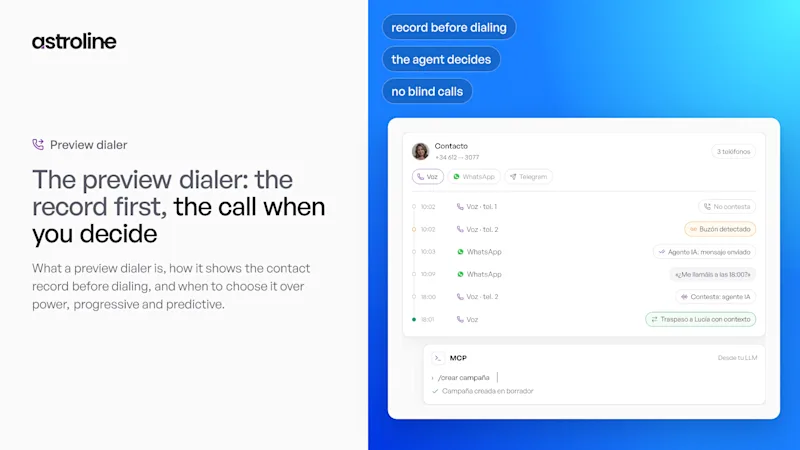
Preview dialer: what it is, how it works, and when to use it
What a preview dialer is, how it shows the contact record before dialing, and when to choose it over power, progressive and predictive.
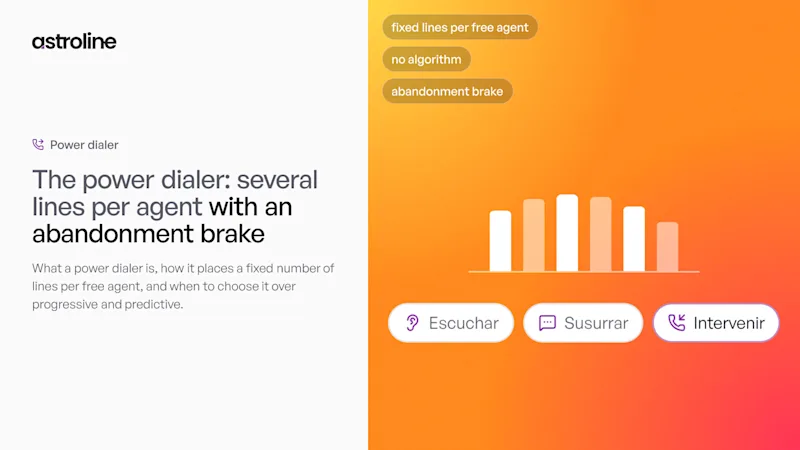
Power dialer: what it is, how it works, and when to use it
What a power dialer is, how it places a fixed number of lines per free agent, and when to choose it over progressive and predictive.
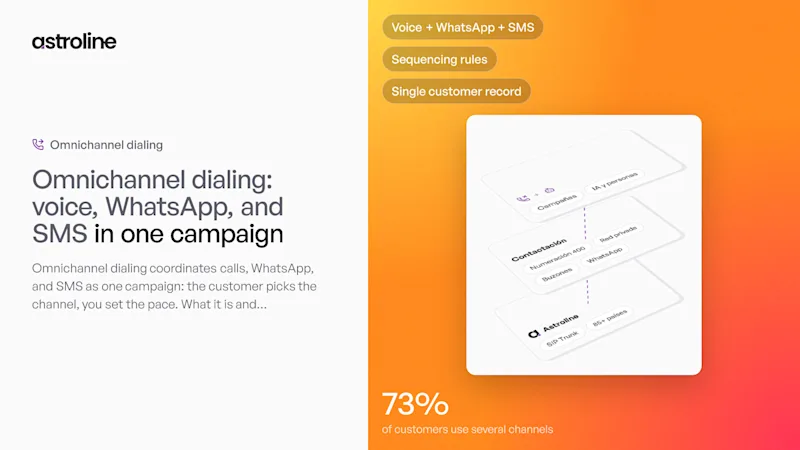
Omnichannel dialing: what it is and how to orchestrate voice, WhatsApp, and SMS
Omnichannel dialing coordinates calls, WhatsApp, and SMS as one campaign: the customer picks the channel, you set the pace. What it is and how to build it.
Newsletter
New articles, in your inbox.
Dialing, voice and AI, without the noise. Unsubscribe anytime.
By submitting, you agree to receive emails from Astroline. See how we handle your data in our privacy policy.