Dialing in the era of AI agents: pacing no longer revolves around humans
September 4, 2026
Predictive dialing is one of the most elegant pieces of engineering in modern telephony, and it was born to solve a very specific problem: no connected call should ever find a human agent busy. The dial ratio, the grace window, abandoned-call control: the dialer’s entire mathematical apparatus revolves around a scarce resource — the free agent.
AI voice agents break that premise. An AI agent does not need to be freed up: it handles concurrent calls, has no variable after-call work or fatigue curve, and works around the clock. When the agent stops being the bottleneck, the question is no longer “at what rate do I dial so humans are never idle?” but “what is worth dialing, and how do I protect every attempt?”.
Dialing does not lose importance. It changes its place.
What predictive dialing actually exists for
Worth remembering, because it has become invisible: a predictive dialer is a machine that synchronizes two clocks. On one side, the time the market takes to answer (PDD, early media, voicemail, no-answer reasons). On the other, the time a human takes to free up (conversation, disposition, breaks).
Its parameters are purely human-centric:
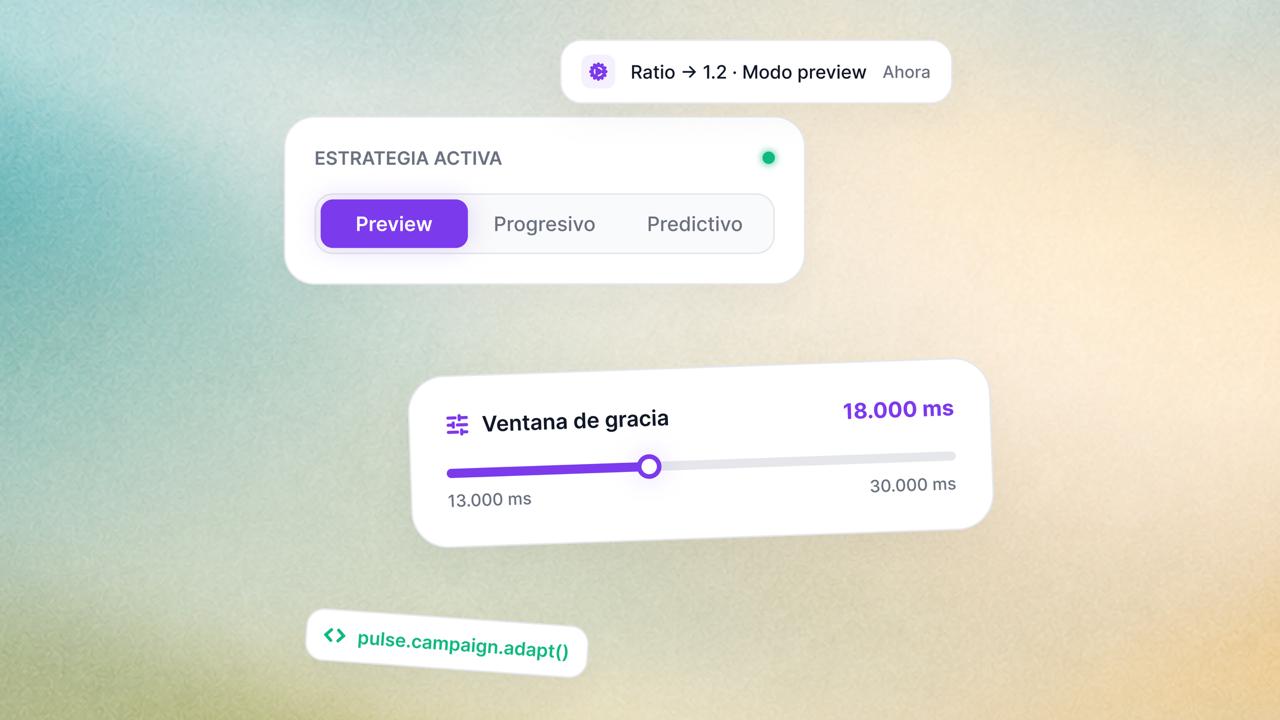
Dial ratio: how many calls to launch per agent expected to free up.
Grace window: the seconds a customer can be kept waiting while you locate an agent. Quality standards measure abandonment below 3%.
Target occupancy: the dialer calibrates so the human is in-call as much as possible, without burning out.
A dialer does not dial faster: it dials at the pace humans free up.
That sentence sums up fifty years of outbound. And it explains why, when the agent is an AI, almost the entire design needs revisiting.
What changes when the agent is not human
An AI voice agent has no occupancy in the classic sense: it can sustain dozens or hundreds of simultaneous conversations, does not disposition between calls, and does not lose performance at three in the morning. Nor does its work need dosing so it doesn’t quit.
The operational consequence is direct: pacing stops being calculated on human rotation and starts being calculated on channel concurrency. You dial up to the limit of simultaneous conversations your operation can sustain with quality — not up to the limit of free agents.
And here is the interesting twist: once agent scarcity disappears, the bottleneck becomes visible somewhere else. Performance stops depending on “will there be someone to answer?” and starts depending on three things that were always there, half-hidden by the conversation about ratios:
Attempt quality: how many of your connected calls are real people and not voicemails, IVRs or false connects.
Your numbering’s reputation: if you get flagged as spam, your dialing capacity is irrelevant.
Cost per effective contact: with AI agents the connected minute is worth more, so every burned attempt weighs more than before.
Dialing as a quality discipline
This is the paradox of the AI-agent era: the dialer matters more, not less. Except its job is no longer synchronizing humans, but protecting every attempt.
Voicemail detection before connecting. Voicemail is the customer who never buys and always gets paid. Our VHunter detector analyzes early media and, if it detects a voicemail, hangs up in under 400 milliseconds — before consuming agent or minute. In live operations this translates into zero billed voicemails and up to 15% more contactability.
Numbering governance. Spam flagging has turned Caller ID into an asset with a lifecycle: you must monitor its reputation, rotate before it degrades, and audit performance per number. Tools like our ASR Vooster measure real contactability per campaign and per number to retire or rest numbering in time.
Multichannel retry. If voice doesn’t reach, the next attempt doesn’t have to be another call. Advanced operations automatically enroll non-contactables into WhatsApp or SMS sequences (with the technology of our partners), so the contact gets the message on the channel they actually check.
Compliance built into the pace. Local calling windows per contact, do-not-call lists, legal basis for processing: modern pacing respects legal windows as seriously as grace windows.
The human floor does not disappear: it reorders
None of this means humans are surplus. It means their time goes where it decides results: the bot opens the call, qualifies and transfers with context on screen; the person closes what has value. Preview mode, almost anecdotal in traditional mass operations, regains meaning for high-value portfolios where every second of context counts.
And the grace window still exists, with a different purpose: it no longer protects agent occupancy, it protects the customer experience. Nobody wants to say hello twice or explain who they are again.
One strategy, several modes
In practice this materializes on platforms where the campaign chooses its mode (preview, progressive or predictive) and combines human and AI agents in the same queue. Our partner PulseDial takes it a step further: agnostic AI voice agents (008, Retell, Vapi, ElevenLabs) that dial, answer and take the queue like any other agent in the operation.
When pacing adapts itself to the strategy, the ratio stops being a sacred number: it is one more variable the campaign adjusts depending on who — or what — answers.
Checklist to redesign your dialing
Calculate pacing on quality concurrency, not on human ratio.
Measure effective contact, not connected calls: separate people from voicemails and IVRs.
Audit false connects per campaign: the most silent leak.
Govern your numbering as an asset: reputation, rotation and rest per number.
Automate multichannel retry for non-contactables.
Design compliance (calling hours, exclusion, consent) inside the dialing engine, not on top.
Dialing stopped being the art of keeping humans busy. It is now the art of protecting every attempt. And that, with AI agents on the floor, is more engineering than ever.
If you are redesigning your outbound operation, at Astroline we help you build it on carrier-grade contactability infrastructure and the technology of our partners. Ask us for a demo and we will look at it with your own numbering and traffic.
Entradas relacionadas

May 28, 2026
Outbound dialing as a performance discipline: why carrier infrastructure decides your contactability

April 22, 2026
WhatsApp Business vs WhatsApp API (Cloud/On‑Prem): what changes in control, governance and scalability when it connects to a contact center
March 19, 2026