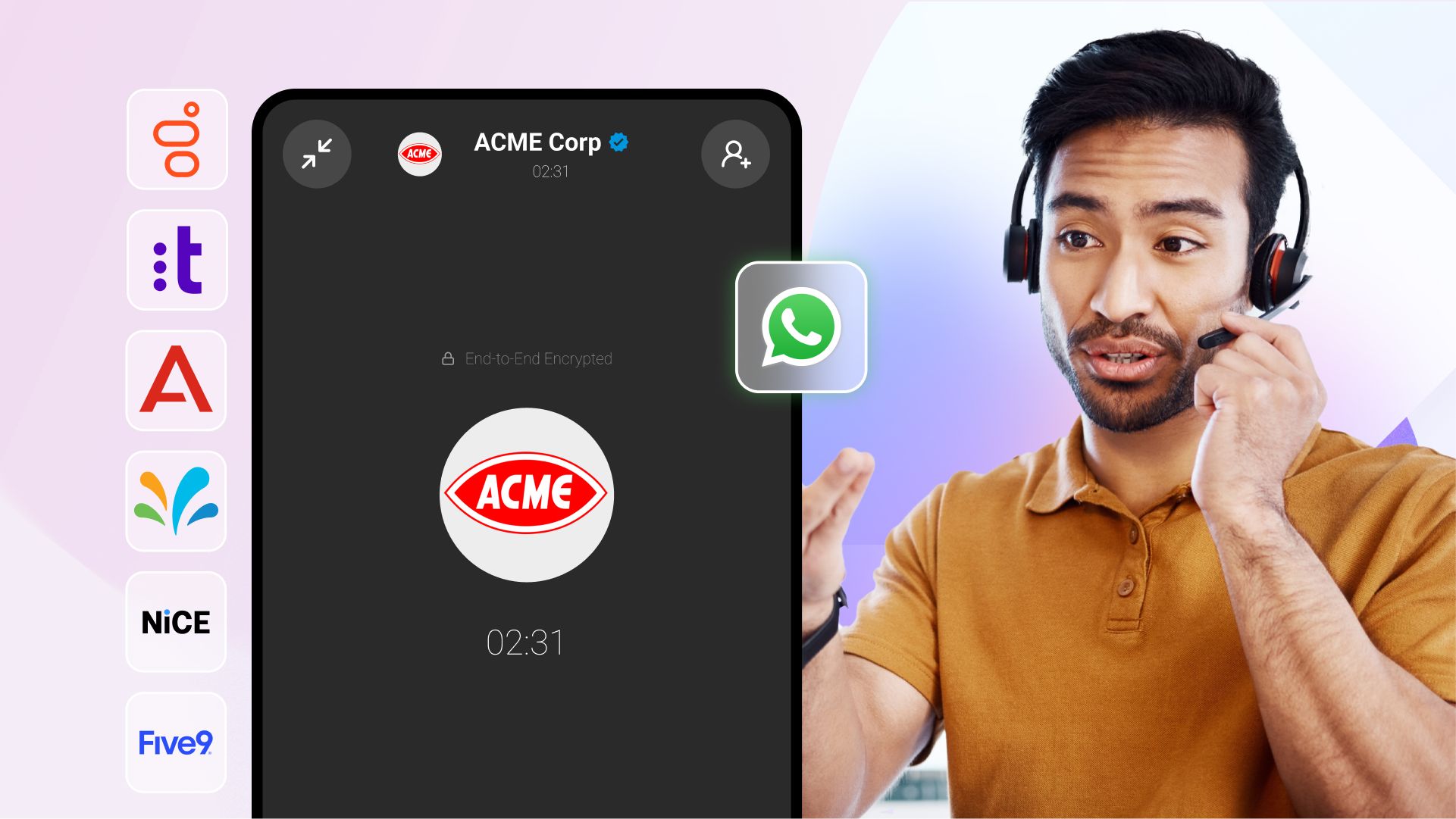
WhatsApp Business Calling: what it really is—and how to fit it into a Contact Center voice architecture
March 19, 2026
WhatsApp Business Calling is gaining attention because it changes where “voice” can start. For a contact center, that matters less as a product announcement and more as an architectural decision: a new entry point that can improve reachability in specific segments, but can also fragment reporting, weaken routing control, and create operational blind spots if it’s bolted on without carrier-grade governance.
This article frames WhatsApp Business Calling the way a Head of Contact Center, Telecom Manager, or CTO needs it framed: what changes in the contactability model, where performance can degrade, and how to fit WhatsApp calling into an existing PSTN stack without losing control of answer rate, cost per successful contact, and continuity.
WhatsApp Business Calling: the executive definition that actually matters
From a contact center perspective, WhatsApp Business Calling is best understood as an additional voice entry point inside a messaging identity ecosystem. It’s not “a replacement for telephony”; it’s a parallel path to conversation that may be preferable for certain customers, certain contexts, and certain brand trust situations—especially when traditional outbound is facing low answer rates due to spam labeling or number reputation degradation.
The key shift is governance. PSTN voice is typically engineered and operated as infrastructure: numbering strategy, routing policy, capacity, failover, and KPI discipline. WhatsApp calling can easily become the opposite: a channel added by a tool owner that lives outside telecom operations, where performance issues are noticed only after conversion drops.
Why decision-makers care: contactability economics, not channel novelty
Most leaders evaluating WhatsApp Business Calling are trying to answer one question: will this increase reachable conversations at a lower cost per successful contact—without creating a new reliability and compliance risk?
In practice, the value shows up (or fails to show up) in operational metrics:
Contactability / reachability: % of attempts that result in a real conversation opportunity, not just “delivered” events.
Answer rate (ASR): for voice legs that still go through PSTN, reputation and routing remain decisive.
Cost per successful contact: total channel cost divided by conversations that meet your “right party contact” definition.
Time-to-contact: how quickly you can establish a live interaction after a trigger (lead, case, delinquency, appointment).
Operational variance: performance stability across geos, carriers, and campaigns—variance is usually where margin disappears.
If you’re already operating a performance-led voice stack, you’ll recognize that these metrics depend on routing control, number lifecycle management, and observability. That’s why WhatsApp Business Calling should be designed into the same operating model as your carrier layer—not treated as “just another digital channel.”
Where WhatsApp calling fits: a reference architecture for contact centers (PSTN + WhatsApp)
The safest way to adopt WhatsApp Business Calling is to assume coexistence with PSTN for the foreseeable future. PSTN remains the backbone for coverage, regulatory expectations, emergency/legacy requirements (in many orgs), and large-scale outbound. WhatsApp becomes a controlled entry point that you can activate when it improves reachability or customer experience.
Principle 1: keep a single routing brain, not two separate ones
When WhatsApp calling is managed in a separate operational silo, you typically get inconsistent skills routing, duplicated business rules, and gaps in overflow logic. Your contact center might hit SLA on the PSTN queue while WhatsApp calls silently back up—or vice versa. The architectural goal is to keep one policy layer for priorities, skills, hours, and fallback, even if there are multiple entry points.
Principle 2: treat WhatsApp as an entry point, but measure outcomes end-to-end
Executives don’t fund channels; they fund outcomes. If WhatsApp calling boosts “engagement” but doesn’t move right-party contact, conversion, or resolution, it will be cut. Your measurement model must reconcile WhatsApp-originated calls with downstream results in CRM/CCaaS reporting, so you can compare it fairly to PSTN attempts.
Principle 3: preserve carrier-grade resilience and fallbacks
A contact center voice architecture needs deterministic failover. That’s typically engineered at the carrier layer: redundant routing, controlled egress, and predictable behavior during incidents. If WhatsApp calling becomes a hard dependency without an operational fallback path, you risk a new class of outage: the channel is “up” from the vendor’s perspective, but unreachable for a segment of users or geographies.
The adoption question isn’t “can we enable WhatsApp Business Calling?” It’s “can we operate it with the same control, resilience, and KPI accountability as PSTN voice?”
The hidden risks: where performance and control are commonly lost
1) Reporting fragmentation and attribution gaps
Many deployments can tell you WhatsApp “initiations” and PSTN “dials,” but not a unified cost per successful contact by segment. That creates bad budget decisions: you may scale the wrong channel because it looks cheaper at the surface level. The fix is to define common outcome events (connected, right party, qualified, resolved) and ensure both entry points feed the same operational reporting cadence.
2) Loss of routing observability
In PSTN, telecom teams can see where calls are failing: carrier response codes, route-level ASR, early media patterns, and number reputation signals. In contrast, WhatsApp calling can be perceived as “opaque,” and issues get attributed to the agent team, the CRM, or the customer. If you can’t isolate the failure domain, you can’t engineer performance.
3) Number asset erosion continues—even if WhatsApp grows
A common misconception is that adopting WhatsApp calling makes PSTN reputation problems irrelevant. In reality, most contact centers will run blended operations for a long time, and PSTN remains critical for reach. If your numbering strategy and caller ID reputation keep degrading, your baseline contactability erodes—raising total cost per contact even if WhatsApp improves a portion of your traffic. That’s why numbering needs lifecycle governance, not ad-hoc procurement; Astroline’s approach to numbering is built to be managed as a performance asset via its dedicated numbering practice.
4) Vendor dependency without a carrier operating model
Contact centers that already run carrier-grade voice know the difference between “feature availability” and “operational control.” WhatsApp calling should be adopted with clear ownership: who owns routing policy, incident response, capacity planning, and performance reviews. Without that, the channel becomes hard to troubleshoot and easy to mismanage during peak periods.
Operating model: how to run WhatsApp Business Calling with performance discipline
Treat WhatsApp Business Calling as part of your voice estate. That means applying the same discipline you already use for outbound and inbound telephony: controlled rollout, route policy design, quality monitoring, and weekly KPI reviews that translate into engineering actions.
Define the decision logic: when WhatsApp vs when PSTN
The mistake is to let customer preference be the only rule. You want a policy that balances customer experience with operational efficiency. Typical decision variables include customer consent and context, geography and time zone, historical reachability, and the business criticality of the interaction (sales vs service vs collections).
Standardize KPIs across entry points
Reachability: percentage of attempts that result in a connected interaction (normalized across channels).
Outcome rate: qualified conversations / connected interactions.
Handle time and resolution: ensure channel gains don’t increase downstream workload.
Cost per successful contact: include telecom costs, platform costs, and labor impact.
Variance: performance by route, geography, and campaign to catch degradation early.
Engineer the PSTN layer to protect baseline performance
Even with WhatsApp calling, your PSTN posture remains a profit lever: routing, redundancy, and number reputation determine what portion of your operation is economically viable. If you’re running outbound or blended voice, a performance-focused SIP architecture matters because it’s where you can control route selection, failover, and quality under load. Astroline typically addresses this at the carrier layer through a smart SIP trunking design that keeps routing policy under telecom ownership rather than pushing it into disparate application settings.
Governance checklist before you scale WhatsApp Business Calling
Ownership: name a telecom owner for routing policy and incident response (not only a digital channel owner).
Coexistence: define which interactions stay PSTN-first and which are eligible for WhatsApp-first.
Fallbacks: document how you maintain continuity when WhatsApp calling is impaired for a segment or geography.
Unified reporting: enforce one set of outcome definitions and one executive dashboard.
Numbering strategy: protect caller ID assets with lifecycle management and rotation policies.
Spam mitigation posture: treat labeling risk as a measurable performance variable, not a “carrier mystery.”
Change control: run staged rollouts and weekly performance reviews with corrective actions.
How Astroline supports WhatsApp + PSTN architectures (without becoming your app layer)
Astroline is a boutique global telecom carrier focused on contactability, reachability, and campaign performance. In WhatsApp + PSTN coexistence, the carrier layer is where you preserve control: redundant routing, smart numbering strategy, spam mitigation intelligence, and early media voicemail detection—so that your baseline voice performance stays stable while you introduce new entry points.
If you operate a modern contact center stack and want WhatsApp Business Calling to improve reachability without sacrificing routing governance, it helps to anchor the design in carrier-grade infrastructure and contact center integration patterns; Astroline’s contact center focus is outlined in its dedicated contact center capability pages.
For organizations rolling out at scale, the main differentiator is how the underlying voice infrastructure is engineered and operated day to day, because that’s what determines variance, recoverability, and the true cost per successful contact over time; this is why Astroline treats its infrastructure as a performance system, not a commodity network.
When to move forward: practical adoption scenarios
WhatsApp Business Calling tends to be a strong fit when you have (1) segments that are hard to reach via traditional outbound, (2) customer bases that already use WhatsApp as a trusted channel, and (3) a contact center operating model mature enough to govern multiple entry points with unified outcomes.
It tends to underperform when it’s introduced as a “CX add-on” without telecom ownership, when outcome attribution isn’t standardized, or when PSTN performance is already unstable and the organization tries to use WhatsApp as a workaround instead of fixing the carrier layer.
Next step: evaluate your architecture against performance and control requirements
If you’re assessing WhatsApp Business Calling, start with architecture and governance before tooling. A short technical and operational review can usually identify where reporting will fragment, where routing control is lost, and how to maintain PSTN number reputation while WhatsApp becomes an additional entry point. If you want to discuss a coexistence design anchored in contactability KPIs, you can reach Astroline’s team through the contact page.
Entradas relacionadas
September 4, 2026
Dialing in the era of AI agents: pacing no longer revolves around humans

May 28, 2026
Outbound dialing as a performance discipline: why carrier infrastructure decides your contactability

April 22, 2026