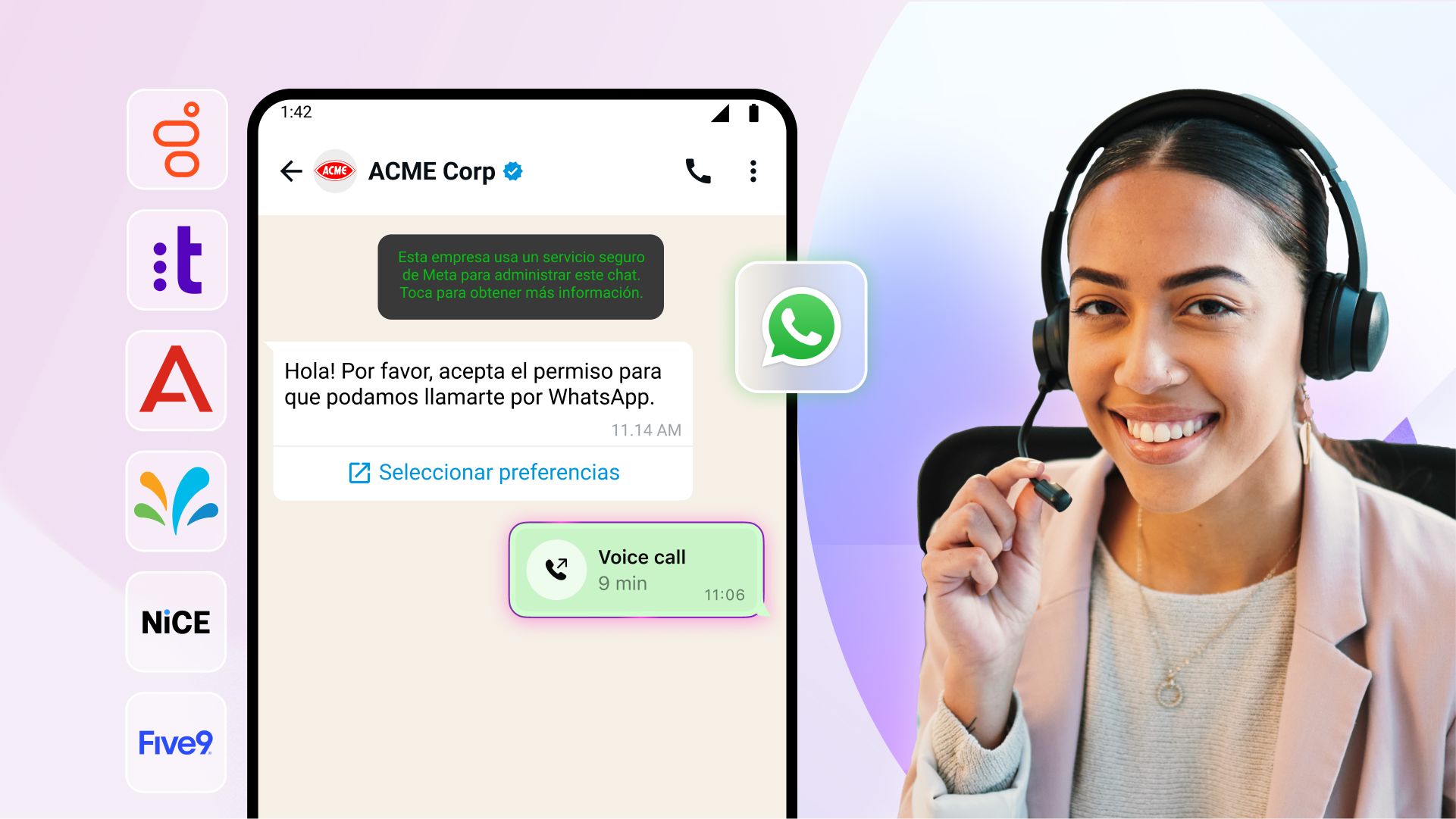
WhatsApp Business Calling for Contact Centers: Designing a PSTN + WhatsApp Entry Architecture Without Sacrificing Caller ID Reputation
March 17, 2026
For many contact centers, the biggest constraint isn’t agent capacity or dialer logic—it’s reachability. Answer rates fluctuate by country, carrier, and even by the specific number you present. As spam labeling increases and number reputation degrades, outbound becomes more expensive: more attempts per connect, more wasted agent time, higher cost per successful contact. WhatsApp Business Calling introduces a different voice entry point: a verified identity surface where customers already spend time. The operational question is not “add another channel,” but how to design a PSTN + WhatsApp inbound architecture that improves contactability without damaging caller ID reputation—and without fragmenting reporting, routing, and governance.
Why WhatsApp Business Calling changes the inbound equation (and what it doesn’t solve)
WhatsApp Business Calling can reduce friction in two common scenarios: 1) When PSTN numbers are being mislabeled or ignored, even for legitimate service calls. 2) When customers prefer to return missed calls through a familiar, identity-forward channel. But it doesn’t remove the need for carrier-grade execution. You still need deterministic routing, continuity controls, and lifecycle management of the numbers behind the operation. If you treat WhatsApp Calling as an isolated endpoint, you typically create new blind spots: duplicated queues, inconsistent SLAs, and unclear cost attribution between PSTN and app-to-app calling. The practical goal is a single voice operations model with two entry points: PSTN for universal reach and WhatsApp for verified engagement—both governed by the same performance discipline.
The coexistence problem: protecting PSTN caller ID reputation while adding WhatsApp as a verified entry point
Caller ID reputation is not a brand asset you “set and forget.” It behaves like an operational metric driven by traffic patterns: • High-volume bursts, low pickup rates, and repeated retries push numbers into risk profiles. • Certain campaign segments (collections, verification, aggressive sales) carry higher complaint and block risk. • Reused numbers across mixed intents (service + sales + collections) accelerate degradation. Adding WhatsApp Business Calling can help absorb returns and service demand, but it can also indirectly harm PSTN if it causes poor queue design (e.g., callers bouncing between channels) or if teams respond to low PSTN pickup by simply increasing outbound intensity. This is why the coexistence design should start with policies—routing, numbering, and reporting—before UI and agent workflows.
Reference architecture: PSTN + WhatsApp inbound entry with a single operational control plane
A robust design aligns both entry points behind one operational model: • Two inbound entry points: PSTN DID(s) and WhatsApp Business Calling. • One routing layer: policy-driven decisions based on intent, geography, time, and capacity. • One queue strategy: consistent skill groups and SLAs regardless of entry channel. • One observability model: unified KPIs to measure contactability and efficiency. In practice, contact centers that take this approach treat telecom as infrastructure: routing intelligence, resilient interconnects, and numbering governance. This is the philosophy behind Astroline’s carrier-grade contact center infrastructure, which is designed to keep reachability measurable and controllable across environments and vendors through a dedicated control layer.
Core components you should define before go-live
Numbering strategy and intent separation (service vs sales vs collections).
Routing rules and failover paths (including what happens when WhatsApp Calling is unavailable, or when queues are saturated).
Identity governance: which customer segments should be encouraged to use WhatsApp Calling, and when.
Reporting model: how you’ll reconcile answer rate, abandon rate, and cost per successful contact across entry points.
Quality controls: early media, voicemail detection behavior, and how the operation treats ambiguous outcomes.
Numbering governance: the lever that determines whether PSTN performance improves or collapses
Most “reputation incidents” are not caused by one bad day—they’re caused by unmanaged numbering: • The same caller IDs used across multiple intents. • No warm-up plan for new numbers. • No rotation rules as volume ramps. • No quarantine process when a number starts degrading. When WhatsApp Business Calling becomes part of your inbound landscape, numbering governance matters even more because you’re now managing customer behavior across channels. The objective is to protect the PSTN surface by designing a numbering lifecycle: allocate numbers by intent, monitor performance, rotate systematically, and retire or rest segments before they become liabilities. If you want the practical foundation for this discipline, Astroline’s approach to numbering strategy focuses on lifecycle control rather than simply “buying more DIDs,” which is key to sustaining reachability over time.
Routing policy design: avoid channel fragmentation and stabilize answer rates
Coexistence fails when routing becomes a set of ad-hoc exceptions. Instead, define a small number of deterministic policies that govern both entry points. Common high-impact policies include: • Intent-based routing: service returns should not share the same queue logic as outbound-driven callbacks. • Geo and timezone routing: WhatsApp Calling can be used to reduce failed attempts in geographies with poor PSTN pickup. • Capacity-aware routing: when the voice queue is saturated, deflect to scheduled callbacks rather than forcing retries that degrade reputation. • Continuity routing: define how traffic fails over between carriers, trunks, or regions without changing the customer-facing identity. These policies require a carrier layer that can execute routing changes quickly and safely. A smart SIP trunking model is often the connective tissue: it lets you enforce routing decisions, introduce redundancy, and instrument performance at the telecom edge rather than only inside the CCaaS layer.
Failover and “graceful degradation” for WhatsApp Calling
Operationally, you should treat WhatsApp Calling as an entry point that can degrade. Your design must answer: • If WhatsApp Calling is unavailable or rate-limited, what is the fallback (PSTN DID, callback scheduling, alternate route)? • If your CCaaS queue is down, can you reroute to a backup site or alternate vendor while preserving reporting? • If a region has elevated spam sensitivity, can you dynamically shift load to numbers or routes with better performance without breaking identity continuity? The point is not complexity for its own sake—it’s minimizing “wasted attempts” and protecting the numbers that keep the operation reachable.
Observability: unify reporting across PSTN and WhatsApp to measure real contactability
If you measure WhatsApp Calling and PSTN in separate dashboards, you’ll optimize the wrong thing. Decision-makers need a unified view of reachability and efficiency. At minimum, define a shared KPI layer: • Answer rate (ASR) by entry point, geography, intent, and caller ID. • Attempts per successful contact (a leading indicator of reputation stress). • Abandon rate and time-to-answer by channel. • Voicemail and early media outcomes (to avoid false “answered” assumptions). • Cost per successful contact: fully-loaded cost of attempts, agent time, and telecom. The carrier layer is where many of these signals are most reliable (e.g., early media, routing outcomes, interconnect behavior). Astroline’s infrastructure focus is built around making those edge signals visible and actionable, so telecom performance can be engineered—not guessed.
Operational playbook: how to introduce WhatsApp Business Calling without destabilizing production
1) Start with a controlled entry segment
Choose one high-value inbound use case where identity and reduced friction matter (e.g., service callbacks, appointment confirmations, VIP support). Avoid starting with the highest-risk segments for complaints and blocks. Define success criteria upfront: answer rate lift, reduced attempts per contact, reduced queue congestion, or improved time-to-resolution. Without this, WhatsApp Calling becomes “more volume” rather than “better contactability.”
2) Separate identities and intents
Do not reuse the same PSTN caller IDs across mixed intents. Keep service identities clean. Use dedicated number pools and routing rules for different outcomes. This is also where WhatsApp Calling can be positioned deliberately: as the preferred return path for segments where verified identity reduces hesitation, while PSTN remains the universal fallback.
3) Engineer routing and reporting as one system
Build routing policies that work whether the call comes from PSTN or WhatsApp. Standardize queue mapping, SLA measurement, and failure handling. Then implement a unified reporting model so leadership can answer one question: did we improve reachability and reduce cost per successful contact, without introducing instability?
4) Put a lifecycle process around number reputation
Treat number reputation as a production risk with an owner and an operating rhythm: • Weekly review of ASR by number and segment. • Rotation thresholds and quarantine rules. • Ramp and warm-up procedures for new numbers. • Controlled retry logic to avoid volume spikes. This discipline is what prevents “PSTN collapse” during peak seasons or when campaign mix changes.
What to expect economically: shifting the cost curve from attempts to successful contacts
When contactability drops, your unit economics degrade quietly: • You pay for more attempts to achieve the same number of right-party contacts. • Agent occupancy becomes noisy—more dialing, more ringing, more voicemail. • Forecasting accuracy worsens because answer rate volatility increases. A well-designed PSTN + WhatsApp entry architecture should target a different economic outcome: fewer wasted attempts and more successful contacts per hour. The business benefit isn’t “a new channel”—it’s stabilizing reachability so you can plan staffing, hit SLAs, and keep telecom costs tied to outcomes rather than volume.
Implementation checklist for Heads of Contact Center and Telecom Managers
Define entry-point roles: what is WhatsApp Calling for, and what remains PSTN-only?
Separate intents with dedicated number pools; avoid mixing service and high-complaint campaigns.
Codify routing policies (intent, geo, capacity, continuity) and test failover behaviors.
Unify KPIs across PSTN + WhatsApp: ASR, attempts per contact, abandon, early media/voicemail outcomes, and cost per successful contact.
Establish number lifecycle governance: warm-up, rotation, quarantine, and retirement.
Ensure carrier-layer observability so routing and reputation decisions are driven by edge signals, not assumptions.
Where Astroline fits: carrier-grade orchestration for multi-entry voice operations
Astroline is not a CCaaS layer. We operate the telecom infrastructure and control plane that makes reachability measurable and improvable: redundant routing, smart numbering strategy, and performance-driven execution at the carrier edge. If you’re evaluating WhatsApp Business Calling and need an architecture that coexists with PSTN without compromising caller ID reputation—or you want a measurable plan to reduce cost per successful contact—we can help you design and operationalize the routing, numbering, and observability model around your contact center stack through our dedicated contact center solutions.
To align on requirements (geographies, traffic profiles, numbering constraints, and routing policies), reach out to Astroline’s engineering team via our contact channel and we’ll map a production-ready coexistence design.
Entradas relacionadas

March 17, 2026
Outbound Calling: Carrier Routing & Failover Design to Protect ASR and Answer Rate

March 13, 2026
Outbound Calling Infrastructure: How Carriers Improve Answer Rate, ASR, and Reachability

March 3, 2026